AI Bathroom Design: Transform Your Bathroom in Minutes
Redesign your bathroom with AI in under 60 seconds. Choose from 100+ styles, get photorealistic renders, and visualize your renovation before spending a dime.
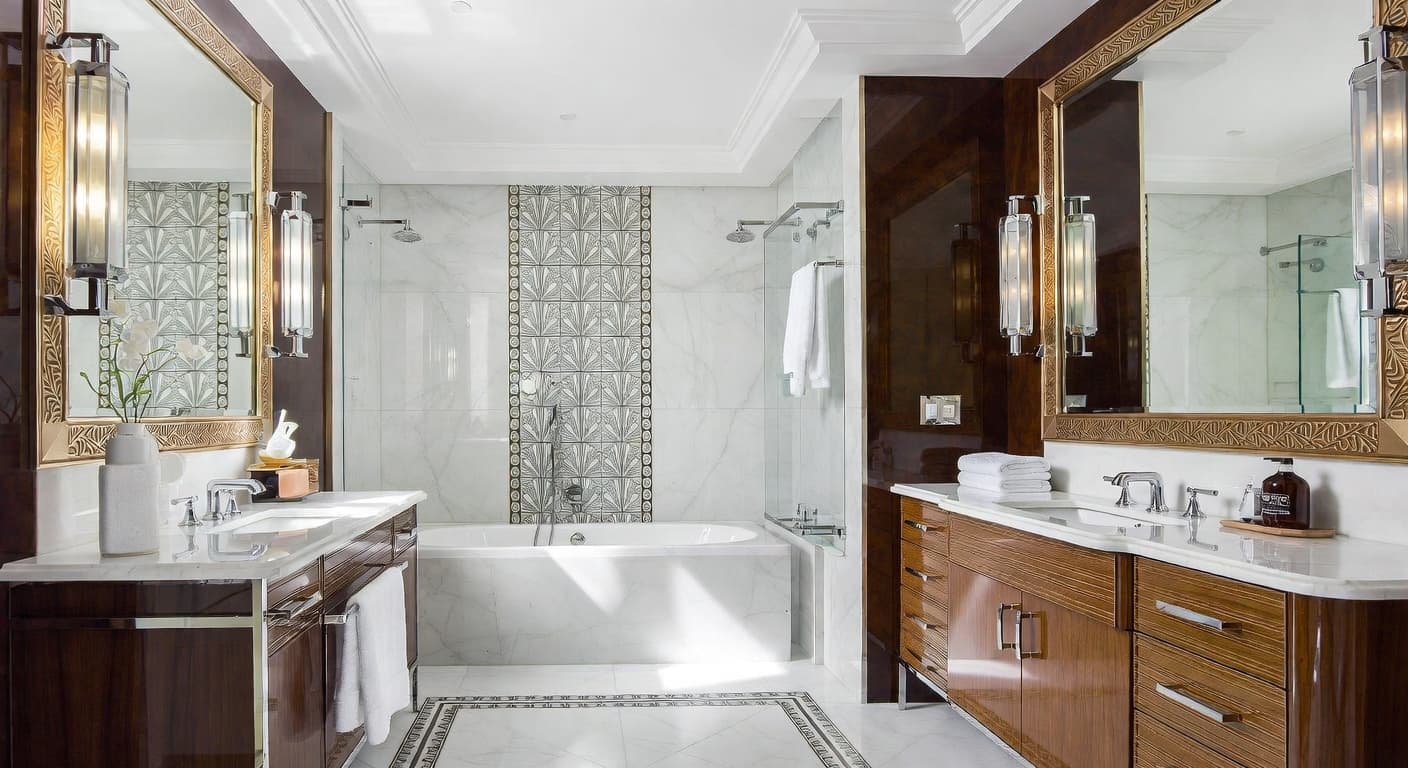
AI bathroom design tools generate photorealistic renders of your bathroom in a new style in under 60 seconds. Upload a photo, select from 100+ design styles, and see exactly how your space would look after a renovation -- before committing to a single tile or fixture.
The short version: an AI bathroom design tool takes a photo of your existing bathroom, applies professional design principles for your chosen style, and returns a photorealistic image showing the transformation. It preserves your room's dimensions and layout while replacing finishes, fixtures, colors, and decor.
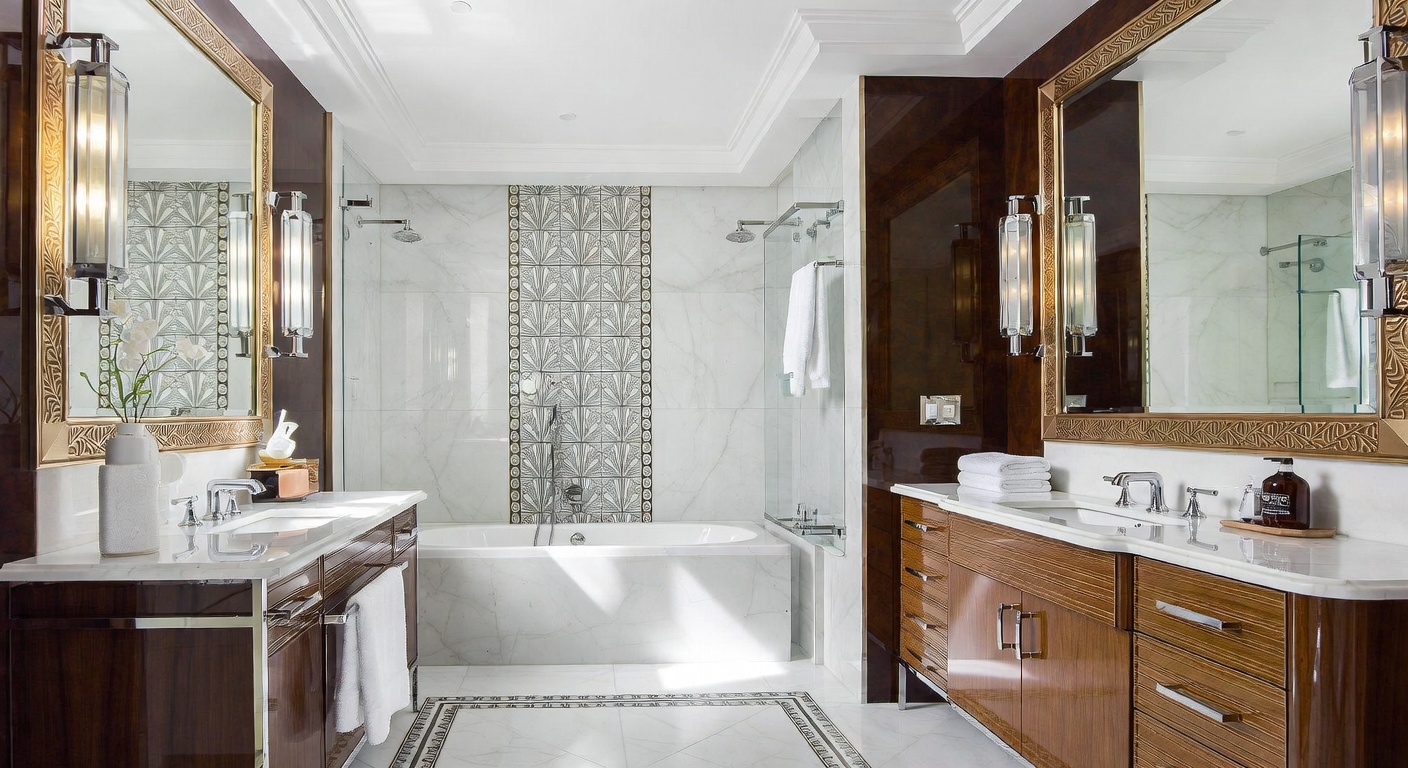
Bathroom renovations are among the most expensive home projects -- averaging $12,000 to $35,000 depending on scope. Choosing the wrong tile, vanity, or layout means living with a costly mistake or paying to redo it. AI design eliminates that guesswork by letting you test dozens of configurations visually before any demolition begins. You can explore everything from a complete gut renovation to a simple refresh -- all from the same photo.
How AI Bathroom Design Works
The process is straightforward. You upload a photo of your current bathroom, and the AI analyzes the space -- walls, floor, fixtures, lighting, and dimensions. You then select a design style, and the system generates a new image showing your bathroom transformed to that style while maintaining the room's actual proportions and structure.
NewInterior AI uses a latest-generation AI model for generation, which produces noticeably more photorealistic results than the older models most competitors rely on. The difference is especially visible in bathrooms, where reflective surfaces like mirrors, glass shower doors, and polished tile demand accurate light rendering. Older AI models often produce blurry reflections or physically impossible tile patterns -- our AI handles these consistently.
You can further customize the output with advanced options:
- Color palette -- specify warm neutrals, bold contrasts, or monochromatic schemes
- Materials -- marble, concrete, wood, terrazzo, or natural stone
- Lighting mood -- bright and airy, warm and ambient, or dramatic and moody
- Budget level -- the AI adjusts fixture and material selections accordingly
Each render takes about 60 seconds. Most users generate 3-5 variations before settling on a direction, and the credit cost makes experimentation practical rather than expensive.
Best Bathroom Styles to Try with AI
Not every design style translates equally well to bathrooms. Some styles thrive in the compact, moisture-heavy bathroom environment. Here are the ones that consistently produce the strongest AI results.
Modern and Minimalist
Clean lines, floating vanities, frameless glass showers, and a restrained color palette. Modern bathroom design is the most popular style choice for a reason -- it makes small bathrooms feel larger and cluttered bathrooms feel organized.
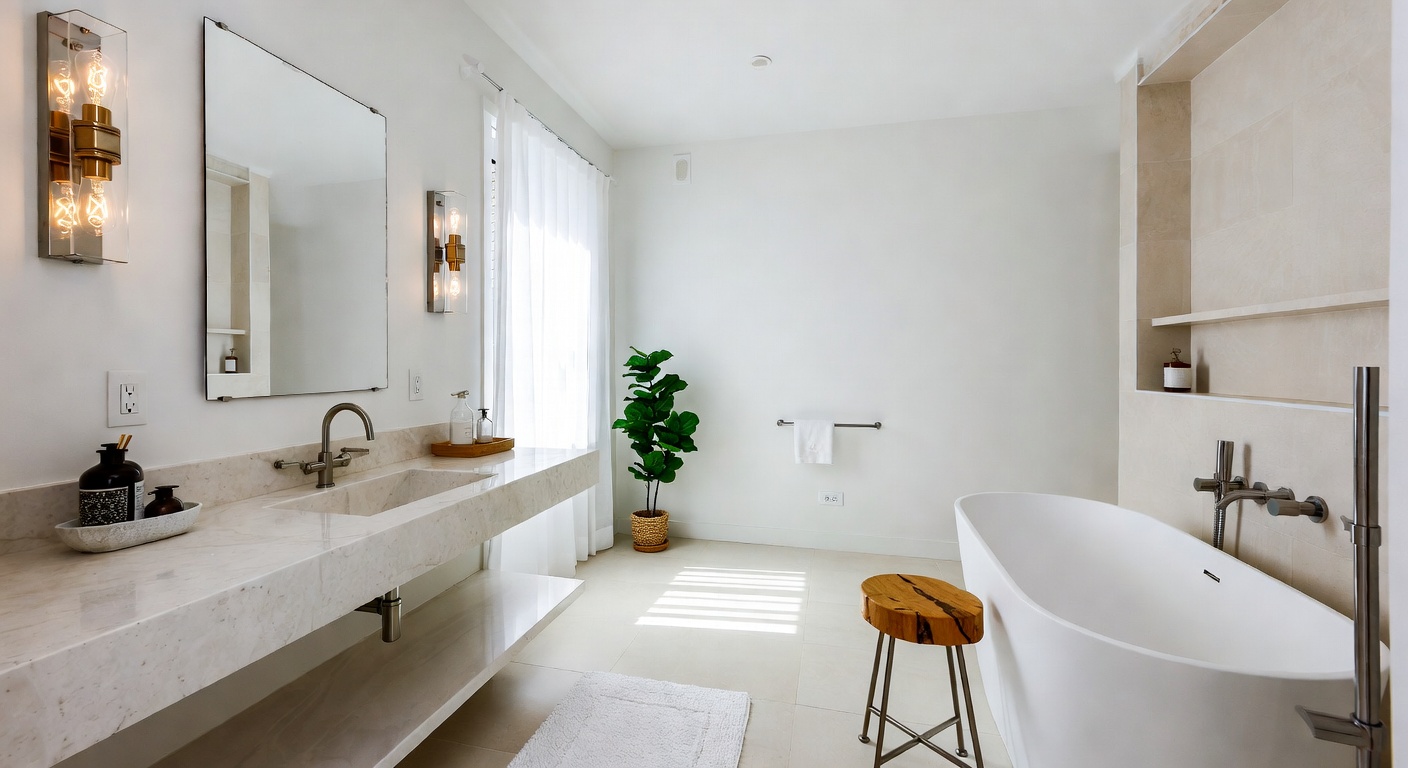
Minimalist bathrooms work especially well for compact spaces. If your bathroom feels cramped, pairing this style with our room-expanding design techniques can dramatically change the perception of space without moving walls.
Japanese and Spa-Inspired
Japanese bathroom design centers on natural materials, soaking tubs, and a sense of calm. The style prioritizes bathing as a ritual, not a rush. Deep Japanese soaking tubs, wood accents, and stone textures define the look.
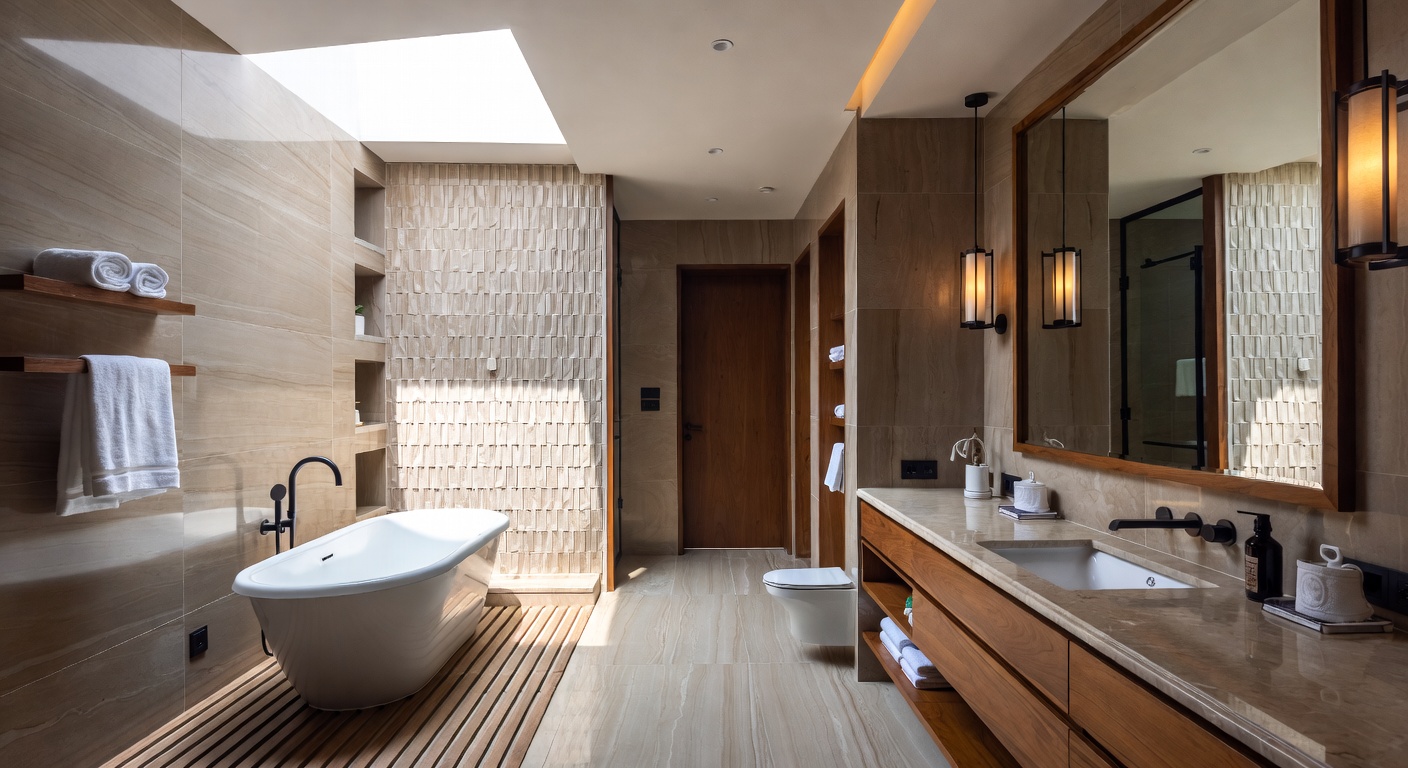
Japanese-style bathrooms are gaining significant search interest, and for good reason. The style pairs beautifully with curbless showers -- a walk-in design that eliminates the shower threshold for a seamless, accessible floor transition.
For a full spa experience, explore our spa and zen bathroom designs to see how steam rooms and relaxation spaces integrate with these principles.
Art Nouveau
Organic curves, nature-inspired motifs, and ornamental detailing make Art Nouveau bathrooms uniquely striking. This style transforms a bathroom into a piece of art -- think floral tile patterns, arched mirrors, and sculptural light fixtures.
Art Nouveau works best in bathrooms with some square footage to spare. The ornamental elements need breathing room to make their impact without overwhelming the space. If you have a master bathroom with a separate tub area, this style can turn that corner into a visual centerpiece.
Mediterranean
Warm terracotta, hand-painted tiles, wrought iron accents, and arched doorways. Mediterranean bathrooms feel sun-soaked even on gray days. The style draws from Spanish, Italian, and Moroccan design traditions, blending them into a cohesive warmth that works in any climate.
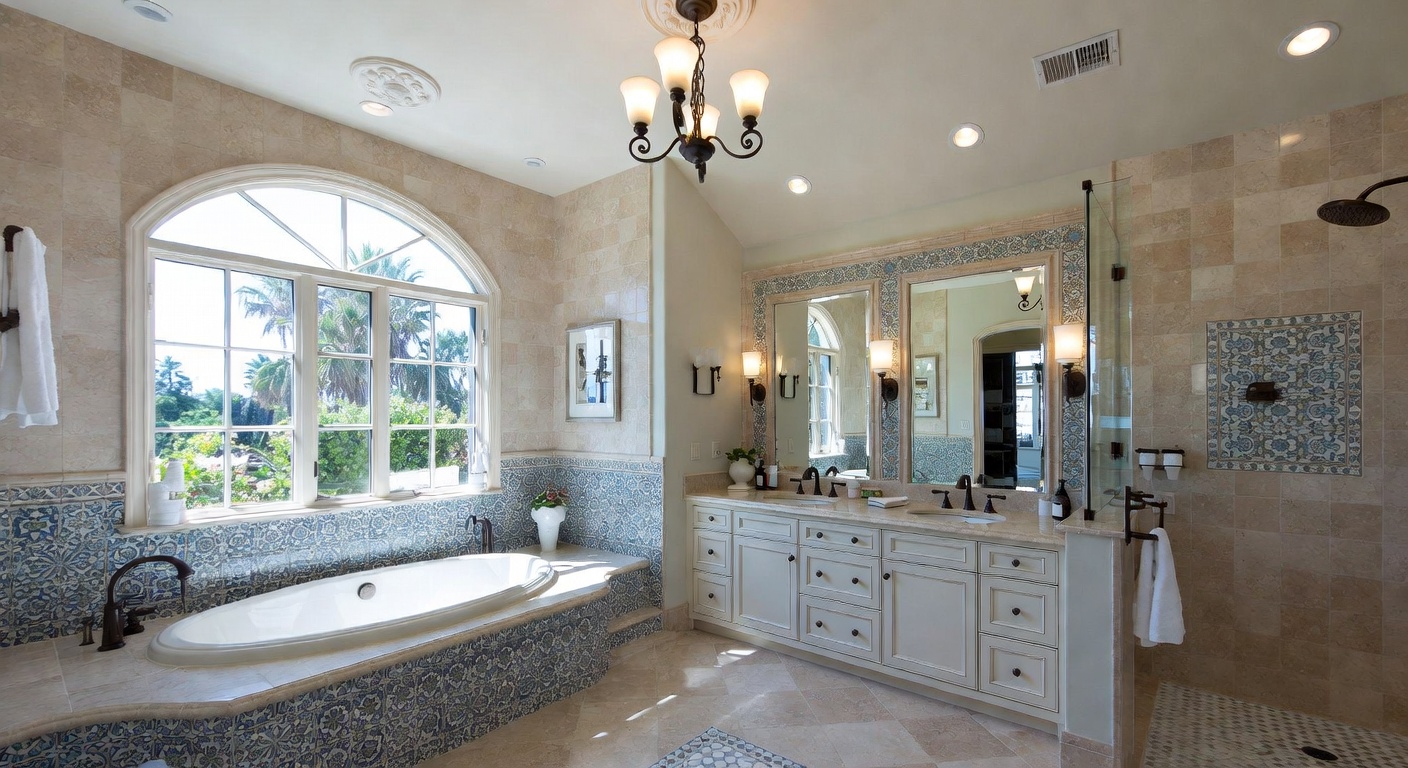
This style pairs naturally with earth tones and textured walls. The AI handles the intricate tile patterns particularly well, showing how zellige or hand-painted ceramic tile would look on your specific walls and floor. It also renders the characteristic textured plaster walls that give Mediterranean bathrooms their depth and character.
Victorian
Clawfoot tubs, pedestal sinks, hexagonal floor tile, and detailed molding. Victorian bathrooms balance ornate detail with functional charm.
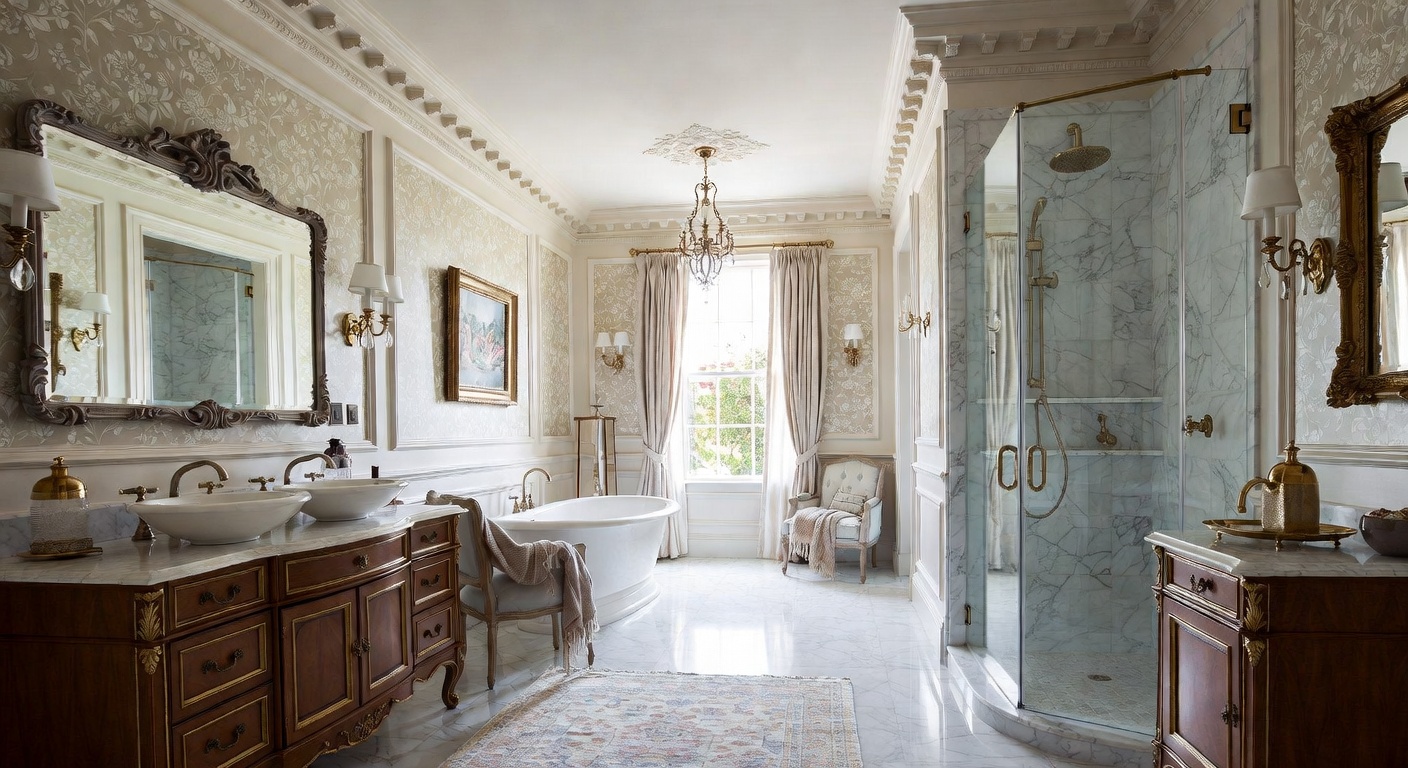
Victorian style suits larger bathrooms where the statement fixtures -- especially a freestanding tub -- have room to anchor the design. The AI renders are particularly useful here because Victorian details are hard to visualize from a tile sample alone. Seeing all the elements together -- the hexagonal floor meeting the wainscoting meeting the pedestal sink -- is what makes or breaks the style.
Small Bathroom Design with AI
Bathrooms under 50 square feet present unique challenges, and most homes have at least one. Every fixture choice matters because there is no visual margin for error. A vanity that is 6 inches too deep or a shower door that swings the wrong way can make the difference between functional and frustrating.
AI design is arguably more valuable for small bathrooms than large ones. Here is why:
You see spatial trade-offs instantly. Should you use a pedestal sink to gain floor space, or a vanity with storage? The AI shows you both options in your actual room so you can compare.
Light colors and glass get tested without commitment. The standard advice for small bathrooms -- light walls, glass shower enclosures, large-format tile -- is easy to say but hard to visualize. AI renders show exactly how these choices interact in your specific space.
Fixture scale becomes obvious. A toilet that looks normal in a showroom might dominate a small bathroom. The AI preserves real proportions, so you can see when a fixture overwhelms the room before you buy it.
The combination of AI bathroom renders and proven space-maximizing techniques gives you a concrete plan rather than abstract advice.
AI Bathroom Remodel: From Render to Reality
An AI render is a starting point, not a blueprint. It shows you the aesthetic direction and confirms your style preferences. Here is how to bridge the gap between a render you love and a bathroom you can actually build.
Step 1: Generate Multiple Variations
Do not stop at one render. Generate your bathroom in 4-5 different styles to understand what resonates. You might assume you want modern minimalist, then discover that a rustic or Mediterranean approach suits your home's existing architecture and cabinetry better. The low cost per render makes this kind of exploration practical.
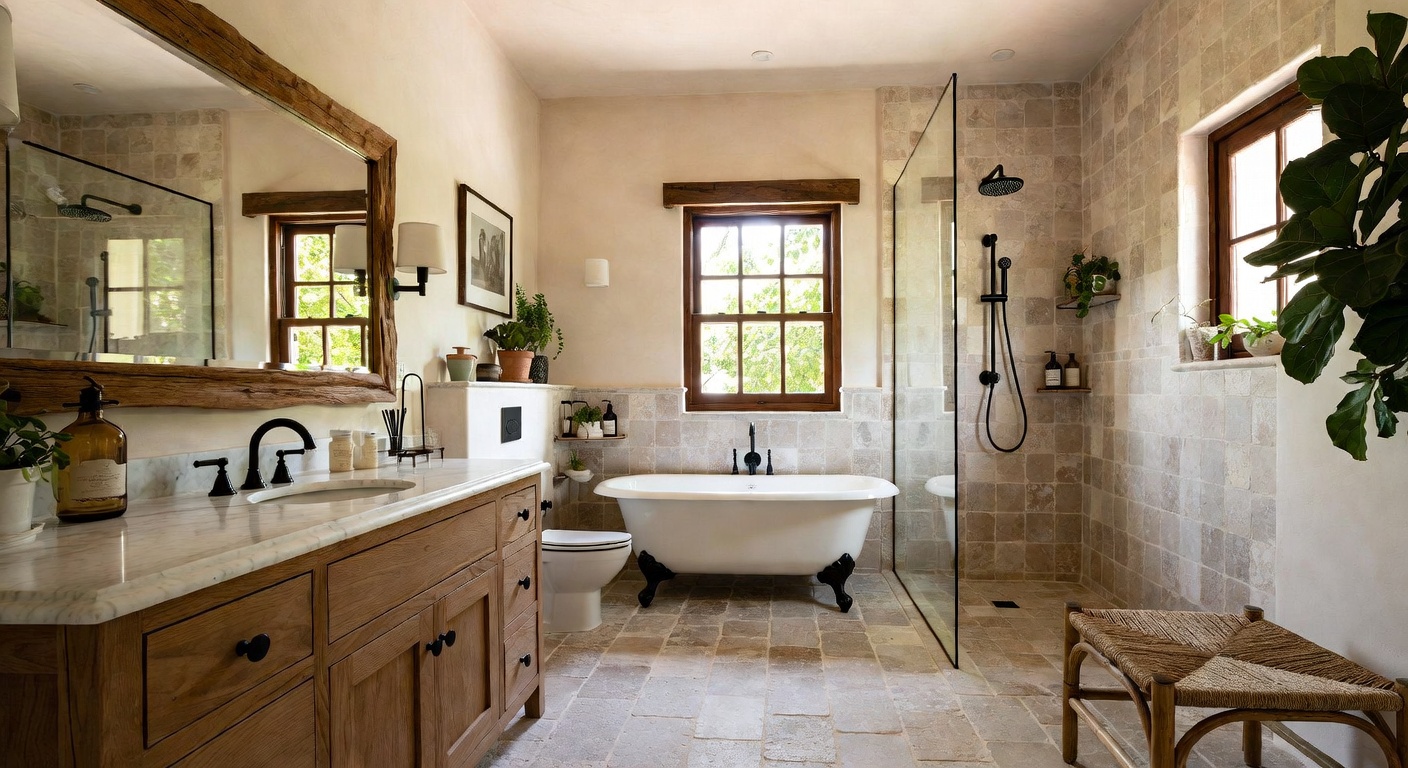
Step 2: Identify Key Elements
Break down each render into its components: floor tile, wall treatment, vanity style, mirror shape, lighting fixtures, and hardware finish. Make a list of the specific elements that drew you to the design. This list becomes your renovation scope -- the more precise you are here, the more accurate your contractor bids will be.
Step 3: Match Real Products
Use the render as a visual shopping list. AI-generated designs show you the aesthetic direction -- now find real tiles, fixtures, and accessories that match. NewInterior AI's style library spans over 100 design aesthetics across 4,182 room and style combinations, so you can find reference images for almost any direction.
Save the render on your phone when visiting tile showrooms and fixture stores. Having the visual reference eliminates the "I'll know it when I see it" problem that leads to decision paralysis.
Step 4: Share with Your Contractor
Contractors work better with visual references than verbal descriptions. "I want something like this" plus a photorealistic render eliminates the miscommunication that leads to costly change orders mid-renovation. A single AI render can replace a 30-minute conversation about your design vision and reduce the risk of mismatched expectations.
Step 5: Iterate as Needed
Changed your mind about the tile after visiting a showroom? Upload the new photo and regenerate. AI design lets you iterate as many times as needed without the cost of physical samples or mockups. Some users generate 10-15 variations over several weeks as they refine their vision -- each one costs a fraction of a single physical tile sample order.
What AI Bathroom Design Costs
NewInterior AI uses a credit-based system. You buy credits upfront and spend them per generation. Medium quality renders cost 5 credits each -- enough to test multiple styles on a modest budget. High quality renders at 25 credits deliver maximum photorealism for final decision-making.
Compare that to the alternatives:
| Method | Cost | Turnaround |
|---|---|---|
| Professional interior designer | $2,000 - $5,000+ | 2-4 weeks |
| 3D rendering service | $200 - $500 per render | 3-7 days |
| AI bathroom design | A few cents per render | 60 seconds |
The speed difference matters as much as the cost. With AI, you can test 20 style variations in the time it takes to explain your vision to a designer once. That rapid iteration leads to better decisions.
Professional designers and 3D rendering services still have their place for complex renovations involving structural changes. But for exploring style directions, testing color schemes, and choosing between finishes, AI renders give you 90% of the value at a fraction of the cost and time.
Frequently Asked Questions
Can AI design a bathroom from an empty room?
Yes. AI bathroom design works with both furnished bathrooms and empty spaces. For empty rooms, the AI places fixtures and finishes based on your chosen style and the room dimensions visible in the photo. The results are most accurate when the photo clearly shows walls, floor, and any fixed elements like windows or doors.
How accurate are AI bathroom renders?
Our AI produces photorealistic results that accurately represent colors, materials, and spatial relationships. The renders show you how a style direction feels in your specific space. They are not construction documents -- exact tile counts, plumbing locations, and structural details still require a contractor or designer.
What photo should I upload for the best results?
A straight-on shot taken from the doorway works best. Use natural light when possible, and make sure the full room is visible in the frame. Portrait orientation captures more of the floor and ceiling. Avoid extreme angles or fisheye lens photos, as they distort proportions.
Does AI bathroom design work for powder rooms?
Absolutely. Powder rooms and half-baths are excellent candidates for AI design because they are small, self-contained spaces where every finish choice is highly visible. The compact size means even a single render gives you a near-complete picture of the final result.
Can I combine two design styles in one bathroom?
NewInterior AI supports style fusion, which blends two aesthetics into one design. Japanese-Scandinavian (Japandi), industrial-modern, and rustic-contemporary are popular bathroom fusions. The AI balances elements from both styles so the result feels cohesive rather than chaotic.
Start Designing Your Bathroom
AI bathroom design removes the biggest risk from bathroom renovation: choosing finishes and fixtures you end up regretting. Test every style you are considering, compare the results side by side, and walk into your renovation with confidence instead of uncertainty.
Try NewInterior AI and see your bathroom transformed in 60 seconds.
Ready to Transform Your Space?
Try NewInterior AI and get professional interior designs in seconds.
Get Started Free